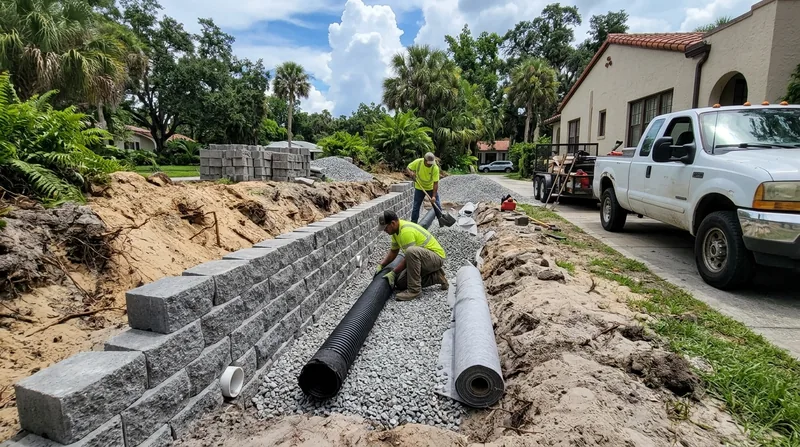




Retaining Wall Drainage in Orlando: Keep Sandy Soil From Pushing Your Wall Over
If you own a retaining wall in Orlando, you already know the ground here is not like the rest of Florida. We sit on deep sandy soil over karst limestone, flat across most of the city but dotted with lakes that pull yards into gentle slopes. After a summer afternoon storm dumps two inches in an hour, that sand turns into a heavy, fluid load pressing straight against your wall. Retaining Wall Drainage in Orlando is the work that lets that water escape before it builds pressure. Without it, even a well-built block or concrete wall will lean, crack, or collapse within a few seasons.
We install, repair, and rebuild drainage systems for every wall type we see across the city: stuccoed CMU planter walls in College Park bungalows, segmental block along lake banks in Winter Park, and aging railroad tie walls holding up driveways out toward Apopka. If your wall is already leaning, start with our leaning and collapsed wall repair page, because drainage alone will not straighten a wall that has already rotated. For walls that are still plumb, drainage is the cheapest insurance you can buy.
Why Drainage Decides Whether an Orlando Wall Lasts or Fails
Hydrostatic pressure is the number one killer of retaining walls in Central Florida, and it is almost always a drainage problem, not a block problem. When rain soaks the sandy backfill, water pools behind the wall because the soil below drains slowly and the wall face seals it in. That saturated sand behaves like a liquid and pushes with far more force than dry soil. Add hurricane-season rain or a week of afternoon thunderstorms, and a wall that looked fine in March can be cracked by September.
- Saturated sand backfill adds hundreds of pounds of lateral load per linear foot once it stops draining.
- Missing weep holes trap water behind stucco and CMU walls until the face cracks or bows outward.
- Clogged French drains silt up with fine Orlando sand and stop working within a few years if they were not built with filter fabric and washed gravel.
- Roof and pool deck runoff dumped behind a wall overloads a system that was sized for rainfall alone.
- Sinkhole settling near lakes and in newer Baldwin Park and Lake Nona subdivisions opens voids that redirect water straight into the backfill.
Every one of these failure modes shows up as the same symptom: a wall that leans, cracks at the corners, or drops a section after heavy rain. Fixing the drainage is what stops the cycle.
Key info: A segmental block wall on a lake bank in Winter Park failed after Hurricane Ian because the original builder backfilled with clean sand and no drain. We rebuilt it with a gravel trench, filter fabric, and a perforated pipe daylighted to the lake. Two seasons later it has not moved.
For the engineering side of how water moves through soil and why drainage matters, the Florida Department of Environmental Protection publishes stormwater guidance that applies directly to lakefront and slope work in Orange County.
How We Build Drainage That Actually Works in Orlando Soil
We do not just drill a few holes in the wall and call it drainage. Orlando's fine sand clogs ordinary filter setups fast, so we build systems that separate soil from gravel and keep the outlet clear. The goal is simple: get water out from behind the wall faster than the rain can put it in. Here is the sequence we follow on a typical job.
- We dig out and inspect the backfill to see where water is actually pooling and how the wall was originally built.
- We install a perforated French drain at the footing, wrapped in filter fabric and set in washed #57 gravel, not local sand.
- We cut weep holes through CMU and concrete walls at the base and at low spots, with gravel behind each one.
- We daylight the outlet to a storm drain, swale, or lake bank so the pipe actually discharges instead of dead-ending.
- We waterproof the back face of concrete and stucco walls with a membrane before we backfill.
- We re-grade the surface so yard runoff flows away from the wall instead of into the backfill.
On lakefront lots in Winter Park and along the ponds in Baldwin Park, that outlet step is the one most contractors skip, and it is the reason those walls fail first.
Key info: A homeowner in College Park had a 3 foot stucco planter wall that cracked every summer. The original drain emptied into a flower bed six inches away. We reran the outlet forty feet to the street swale and the cracking stopped.
If you are planning a new wall and want the drainage designed in from the start, our block and segmental retaining walls page covers how we build the base and backfill correctly the first time.
Drainage Approaches We Use on Orlando Walls
Not every wall needs the same system. A short planter wall behind a bungalow in Thornton Park is a different job from a six foot lake bank wall in Clermont. We match the approach to the wall height, the soil, and where the water can legally go.
| Approach | Description | Best for |
|---|---|---|
| Footing French drain | Perforated pipe in washed gravel with filter fabric, daylighted to a safe outlet. | Most block, concrete, and timber walls over 2 feet tall. |
| Weep holes and gravel pockets | Cored holes through CMU and stucco with gravel behind each opening. | Stucco planter and pool deck walls common in College Park and Lake Eola Heights. |
| Chimney and gravel backfill | Vertical gravel columns that let water drop to the footing drain. | Tall segmental walls and tiered walls on sloped lots. |
| Surface re-grading and swales | Reshaping the yard so runoff flows around the wall, not into it. | Walls at the bottom of a slope in Apopka and Clermont. |
| Waterproof membrane | Sheet membrane on the back face of concrete and stucco walls before backfill. | Poured concrete walls and basement-style retaining structures. |
Most Orlando jobs combine two or three of these. We tell you which ones your wall actually needs after we see the backfill.
Retaining Wall Drainage Cost in Orlando: What to Expect
Drainage work starts around $2,500 for a straightforward footing drain with a clear outlet, and it is the least expensive way to protect a wall that is still standing straight. That figure covers the trench, pipe, gravel, filter fabric, and a working outlet on a typical residential wall. From there, price climbs with wall length, wall height, and how hard it is to reach the back of the wall with equipment.
Several things move the number. A long lake bank wall in Winter Park needs more pipe and gravel than a short planter wall in Thornton Park. Tight access behind a bungalow, where we cannot get a machine in, adds hand labor. If the wall is already leaning, drainage alone will not fix it, and you are looking at repair or replacement instead, which is a different budget. Adding weep holes through a stucco CMU wall is quick. Tearing out a failed railroad tie wall and rebuilding the drainage behind a new one in Apopka is a bigger job.
We recommend getting two or three written estimates for any drainage job, and asking each contractor where the outlet will discharge. A price that leaves the outlet buried in a flower bed is not a real drainage system. Our full pricing overview breaks down how we build these numbers.
Retaining Wall Drainage Near Me: How to Pick a Contractor Near Orlando
Drainage is invisible once the job is done, so the contractor's habits matter more than the finished look. Ask questions before you sign anything. A wall that fails in two years costs far more than the difference between two estimates.
- Confirm the contractor is fully insured in Florida, and ask for a certificate of insurance before work starts.
- Get at least two or three written estimates that spell out pipe size, gravel type, and the outlet location.
- Ask for references from jobs in your part of town, especially lakefront or sloped lots like yours.
- Check whether your wall needs a permit. Many Orlando-area jurisdictions require one for walls above roughly 4 feet from the footing, or when the wall supports a driveway or structure, so call the local building department to verify.
- If you live in an HOA community in Lake Nona or Baldwin Park, confirm the drainage outlet and any visible changes are allowed before work begins.
We are happy to walk you through what your wall needs and put it in writing. Reach us through our contact and free estimate page or call (407) 955-9875.
When Drainage Is Not Enough
Sometimes the water has already done its damage. If your wall is leaning more than a few inches, has a visible crack running through the block, or dropped a section after a storm, drainage is part of the repair, not the whole repair. In those cases we look at retaining wall repair or full replacement, and we build the drainage in correctly the second time. Catching it early is what keeps a $2,500 drainage job from turning into a wall rebuild.
Retaining Wall Drainage in Orlando: Pricing Guide
| Service | Price | Details |
|---|---|---|
| Footing French drain (standard residential wall) | Starting at $2,500 | Includes trench, perforated pipe, washed gravel, filter fabric, and a daylighted outlet on a typical wall. |
| Weep holes and gravel pockets (CMU or stucco wall) | Starting at $650 | Cored holes with gravel behind each opening; price rises with wall length and number of holes. |
| Full drainage rebuild with wall repair | On estimate | Needed when the wall is leaning or cracked; requires on-site look at backfill and footing condition. |
| Lake bank or sloped lot drainage | On estimate | Outlet routing, erosion control, and permitting vary by site; we assess slope and discharge point first. |
| Travel | Included | In Orlando and surrounding areas, no separate call-out or mileage fee. |
| Estimate | Free | Response within 24h at (407) 955-9875, no obligation to book. |
Indicative pricing, the exact cost depends on square footage, finish, and site access. Free personalized estimate within 24h at (407) 955-9875.


