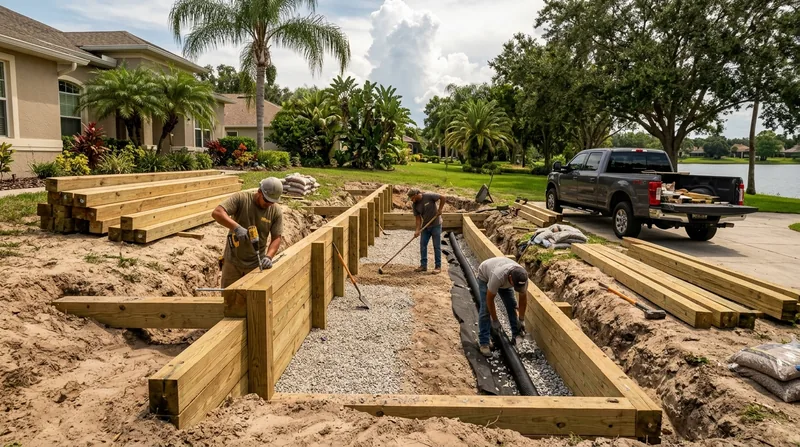




Orlando sits on sandy Central Florida ground over karst limestone, and most of the city is flat except where yards slope gently down to the chain of lakes. That means a timber retaining wall in Orlando often does one job: holds back a low garden bed, a raised planter, or a small grade change beside a patio. Pressure-treated timber is the budget-friendly choice for those spots, and we tell homeowners honestly when it makes sense and when a longer-lasting material is the better call. The afternoon storms that roll through in June and September soak sandy backfill fast, and a wall built without drainage will lean within a season or two. If you already have a wall that is bowing or has collapsed, start with leaning and collapsed wall repair before you think about new timber.
Why Timber Walls Fail Fast in Orlando's Sandy Soil and Storm Season
Orlando's soil is mostly sand over limestone, and sand does not hold water. When a summer downpour dumps two inches in an hour, the water pushes through the backfill and finds every gap. Timber walls that lack a gravel drainage column and a proper outlet rot from the wet side out, and the posts loosen as the sand shifts. We see this most in older College Park and Thornton Park yards where landscape timbers have been in the ground since the 1990s.
- We inspect the posts for rot at and below grade, because that is where treated timber gives out first in Orlando's humidity.
- We check whether the wall has a gravel drainage column and an outlet, since saturated sand is the leading cause of lean.
- We look for washout at the base, which happens when storm runoff runs along the wall instead of away from it.
- We flag any wall over roughly 4 feet or holding up a driveway or structure, because that scope usually needs a permit and often engineered drawings.
If your timber wall is already leaning, patching it rarely holds, and replacing it with a material that handles Orlando's wet season is usually the cheaper long-term move.
Key info: A homeowner in Baldwin Park had a 3-foot timber wall along a pond-side bed that leaned after one hurricane-season rain event. The posts were rotted six inches below grade, and no gravel had been placed behind the boards. We rebuilt it with drainage and a segmental block face because the wall sat in the flood-prone zone.
Permit thresholds vary by jurisdiction, so always confirm with the local building department before you build. The City of Orlando's permitting portal is a good starting point: City of Orlando permits.
How We Build a Timber Wall That Lasts in Orlando
We start by checking the grade and the soil, then we set the wall line and dig the footing trench below the frost line, which in Orlando means below the root zone of the lawn. We use pressure-treated lumber rated for ground contact, set posts in compacted gravel, and build a gravel drainage column behind the boards with a filter fabric so sand does not clog it. Every wall we build gets an outlet that moves water away from the base.
- We mark the wall line and confirm the height against the local permit threshold before we dig.
- We excavate the footing trench and compact a gravel base so the posts do not settle into Orlando's sandy subgrade.
- We set pressure-treated posts and tie them back into the slope where the wall holds a grade change.
- We install filter fabric, a gravel drainage column, and a daylighted outlet behind the wall.
- We cap the wall and backfill in lifts, compacting each lift so the sand does not wash out in the next storm.
For a low garden border in Winter Park, that process takes a day. For a taller wall or one on a slope, we plan two to three days and schedule around the afternoon storms.
Key info: In Clermont, where the ground actually rolls into hills, a homeowner wanted timber to hold a 4-foot cut behind a pool deck. We priced it, then showed him why a segmental block wall would cost about the same once the engineering and drainage were done right. He went with block, and the wall has held through two wet seasons.
If your project is more than a low border, see our retaining wall installation page for how we handle grade changes and permits.
Timber Wall Approaches We Use in Orlando
Not every timber wall is built the same way, and the right approach depends on height, soil, and what the wall is holding back. Here is how we match the method to the job.
| Approach | Description | Best for |
|---|---|---|
| Post-and-board timber wall | Pressure-treated posts set in gravel with horizontal boards and a gravel drainage column behind. | Low garden beds and raised borders up to about 3 feet. |
| Treated timber with tiebacks | Posts tied back into the slope with deadmen to resist overturning in saturated sand. | Walls 3 to 4 feet holding a grade change beside a patio or walk. |
| Timber planter and seat wall | Short timber walls that double as planter edges and bench seating around pool decks. | Pool deck borders and landscape planters in Lake Nona and Baldwin Park. |
| Timber-to-block replacement | Removing rotted timber and rebuilding the wall in segmental block with proper drainage. | Aging timber walls that have already leaned or rotted at grade. |
We recommend the approach based on what the wall holds and how long you want it to last, not on what is easiest to sell.
Timber Retaining Walls Near Me: What Orlando Homeowners Should Know
When you search for timber retaining walls near me, you will find a wide range of quotes, and the difference is usually in the drainage and the footing, not the lumber. A cheap wall built without a gravel column and an outlet will lean in Orlando's storm season. Ask any contractor how they handle water behind the wall before you compare price.
- Ask whether the contractor is fully insured, and request a certificate before work starts.
- Get two or three written estimates so you can compare the drainage detail, not just the total.
- Ask for references from jobs in your part of Orlando, especially walls that have been through a wet season.
- Confirm whether your HOA or the local building department requires approval, since many Orlando communities have design rules for visible walls.
A few extra questions up front save you from rebuilding the same wall in three years.
Timber Retaining Walls Cost in Orlando: What to Expect
Timber is the least expensive wall material we install, and most low garden walls in Orlando start around $20 per square foot of wall face. That figure covers pressure-treated lumber, posts, gravel, filter fabric, and labor for a straightforward wall on flat ground. The price moves up when the wall is taller than about 3 feet, when access is tight behind a pool cage, or when we have to remove an old rotted wall first.
Three things drive the number more than anything else: height and length of the wall, how much excavation the site needs, and whether the wall holds a surcharge like a driveway or structure. A wall that needs engineered drawings or a permit will carry that cost on top. We give you a written scope so you can see what is included, and we tell you when a different material would be the better spend. For a fuller breakdown, see our pricing page.
Getting two or three estimates is smart because it forces each contractor to spell out the drainage and footing, which is where cheap bids cut corners.
What to Look for When Hiring a Retaining Wall Contractor Near Orlando
Hiring the right contractor matters more for retaining walls than for most home projects because a failed wall can damage a pool deck, a driveway, or a foundation. Start with fully insured status, and ask for the certificate, not just a verbal yes. Then get multiple estimates and compare the scope line by line.
Ask for references from walls in your area and, if possible, look at a wall the contractor built two or three seasons ago. Confirm who pulls the permit if one is required, and check your HOA rules before you sign. If your property has protected trees near the wall line, confirm the local rules before anyone digs. We are happy to walk you through the process at our contact page, and we will tell you plainly if timber is not the right call for your site.
Timber Retaining Walls in Orlando: Pricing Guide
| Service | Price | Details |
|---|---|---|
| Low timber garden wall (up to 3 ft) | Starting at $20/sq ft | Includes pressure-treated lumber, posts, gravel drainage, filter fabric, and labor on flat ground. |
| Timber wall with tiebacks (3 to 4 ft) | Starting at $28/sq ft | Adds deadmen tiebacks and deeper footing for walls holding a grade change beside a patio. |
| Timber planter or seat wall | Starting at $22/sq ft | Short walls around pool decks and planters, priced by linear foot of face. |
| Timber-to-block replacement | On estimate | Needs an on-site look to price removal, disposal, and the new block wall and drainage. |
| Travel | Included | In Orlando and surrounding areas, no separate call-out or mileage fee. |
| Estimate | Free | Response within 24h at (407) 955-9875, no obligation to book. |
Indicative pricing, the exact cost depends on square footage, finish, and site access. Free personalized estimate within 24h at (407) 955-9875.


