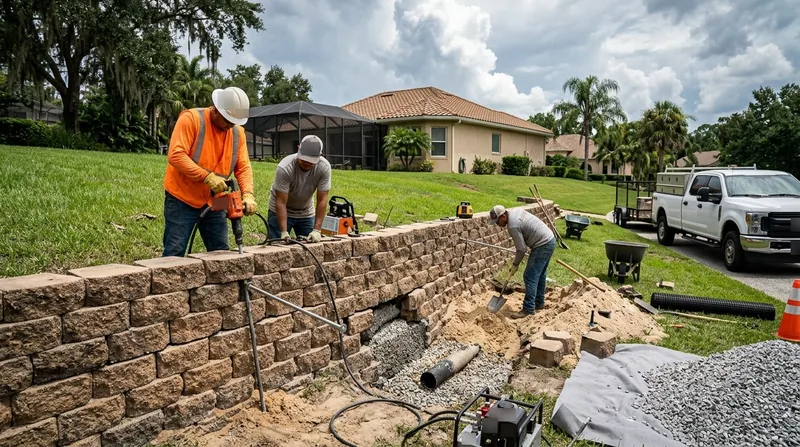




Orlando sits on sandy ground over karst limestone, flat across most of the city but dotted with lakes, so plenty of yards slope gently down to the water. In College Park, Thornton Park and Lake Eola Heights, 1920s and 1930s bungalows and Mediterranean Revival homes sit behind stuccoed CMU planter and pool deck walls. Winter Park mixes old estates with chain-of-lakes waterfront, while Baldwin Park and Lake Nona built raised pads beside ponds. Those walls fail from saturated sand in afternoon storms, washout, and sinkhole settling. If your wall is leaning, bowing, cracked or settling, Retaining Wall Repair in Orlando stops the failure before it becomes a collapse. We correct drainage, install tieback anchors, and rebuild failed sections. Start with our leaning and collapsed wall repair page if the wall is already moving.
Why Retaining Wall Repair Matters on Orlando's Sandy, Lake-Dotted Ground
Central Florida's sandy soil drains fast until a summer storm dumps two inches in an hour, then it turns heavy and pushes hard against a wall. The karst limestone below can settle or wash out, and lakefront lots in Winter Park and along the Butler Chain take the worst of it. Walls that look fine in March can bow by August. Repairing early is almost always cheaper than replacing a collapsed wall.
- Saturated sand behind a wall adds thousands of pounds of pressure during afternoon storms and hurricane rain.
- Clogged weep holes and missing drain rock let water build up until the wall leans or cracks.
- Sinkhole settling under footings opens gaps that show up as stair-step cracks in block walls.
- Aging timber and railroad tie walls rot at the soil line and fail suddenly after ten to fifteen years.
- Pool deck and planter walls on stuccoed CMU crack when roots or settling move the footing.
We see all five failure modes every week across Orlando, and each one has a different fix. The right repair depends on what is actually moving and why.
Key info: A segmental block wall along a Lake Nona pond bank that leans after a storm usually has a drainage problem, not a block problem. We pull the top courses, clear the clogged drain core, add washed rock and a new outlet, then reset and compact the block. That repair often costs far less than a full rebuild.
How We Diagnose and Repair a Failing Wall in Orlando
We start by finding out what is actually moving. A wall that leans out at the top is a different repair from one that settles at the base or cracks mid-panel. We check the soil, the drainage, the footing and the load behind the wall before we quote anything. Then we build the repair around the cause, not just the symptom.
- We walk the wall and mark every crack, lean, bulge and settlement point with the homeowner present.
- We probe the drainage behind the wall and check weep holes, drain rock and outlet pipes.
- We check the footing depth and soil condition, especially on lakefront and sloped lots.
- We recommend the least invasive repair that will actually hold, from drainage correction to anchors to a partial rebuild.
- We pull permits through the local building department when the wall height or surcharge requires it.
- We rebuild, anchor or drain the wall, then compact and restore the surface behind it.
Every repair ends with a drainage check, because water is what took the wall down the first time. If the wall is on a slope above a lake, we may also recommend slope stabilization to keep the bank from moving again.
Key info: On a 1970s block wall in College Park, the homeowner saw a two-inch lean at the top. We found the original drain rock packed with sand and roots, and the outlet buried under a patio slab. We cleared the drain, added tieback anchors to the top two courses, and the wall pulled back straight without a full rebuild.
Repair Methods We Use on Orlando Walls
Not every wall needs the same fix. A leaning segmental block wall on a pond bank in Kissimmee may need anchors and drainage, while a cracked stuccoed CMU planter wall in Thornton Park may need a partial rebuild and a new footing. We match the method to the wall type and the failure.
| Approach | Description | Best for |
|---|---|---|
| Drainage correction | Clear weep holes, replace drain rock, add outlet pipe and surface grading | Walls that lean or weep after storms but are otherwise sound |
| Tieback anchors | Helical or grouted anchors pull the top of the wall back and hold it | Leaning block or concrete walls with good footing |
| Partial rebuild | Remove and reset failed courses, rebuild footing where needed | Cracked or bulging sections, settling at the base |
| Timber and tie replacement | Pull rotted timbers and replace with block or new treated timber | Aging landscape timber and railroad tie walls |
| Stucco and CMU crack repair | Route and seal cracks, re-stucco, correct footing settlement | Pool deck and planter walls on Orlando bungalows |
We choose the method after we see the wall, not before. That is how we avoid selling a rebuild when a drainage fix will hold.
Retaining Wall Repair Cost in Orlando: What to Expect
Most retaining wall repairs in Orlando start around $1,500 and go up from there. A drainage correction on a small planter wall sits near that starting point. Tieback anchors, partial rebuilds and lakefront work with tight access run higher. The number depends on wall length and height, how deep the failure goes, access for equipment, and whether the wall supports a driveway or structure.
We give you a written scope with the repair method and the price before we start. We recommend getting two or three estimates on any repair over a few thousand dollars, and asking each contractor what they found behind the wall. Our full pricing overview breaks down the ranges by repair type.
Retaining Wall Repair Near Me: How to Choose a Contractor Near Orlando
When you search for retaining wall repair near me, you will get a long list of names. The right contractor can explain what failed, show you proof of insurance, and tell you whether your wall needs a permit. Ask questions before you sign anything, and do not pick on price alone.
- Confirm the contractor is fully insured and ask for a certificate before work starts.
- Get at least two or three written estimates with the repair method spelled out.
- Ask for local references, especially on lakefront or sloped lots like yours.
- Ask who pulls the permit and whether your city requires engineered drawings for tall or tiered walls.
- Check HOA rules before you change wall height, material or color.
If a contractor cannot answer those questions, keep looking. You can request a free estimate from us and compare it against the others.
When to Repair and When to Replace an Orlando Retaining Wall
Repair makes sense when the wall is structurally sound and the failure is drainage, a leaning top, or a cracked section. Replacement makes sense when the footing is gone, the wall has collapsed, or more than half the wall has failed. On older timber and railroad tie walls in Sanford and Apopka, replacement is usually the better call because the wood is rotten through.
We tell you honestly which one you need. If a repair will hold for years, we quote the repair. If it will not, we explain why and quote the replacement. Our retaining wall replacement page covers what that job involves.
Seasonal Timing for Retaining Wall Repair in Orlando
Orlando's rainy season runs from June through September, and that is when most wall failures show up. Afternoon storms saturate the sand behind a wall, and hurricane rain can push a leaning wall over in a single event. The dry months from November through April are the best time to repair, because the soil is stable and the work goes faster.
Do not wait for the dry season if your wall is already leaning or cracked. A wall that moves in August can collapse in the next storm. We schedule repairs year-round and prioritize walls that are actively failing. Call (407) 955-9875 if you see new movement after heavy rain.
Retaining Wall Repair in Orlando: Pricing Guide
| Service | Price | Details |
|---|---|---|
| Drainage correction and weep hole repair | Starting at $1,500 | Clears clogged drain rock and outlets, regrades surface, resets top courses on small walls |
| Tieback anchor installation | Starting at $2,800 | Helical or grouted anchors pull a leaning wall back, priced by wall length and anchor count |
| Partial rebuild of failed section | Starting at $3,500 | Removes and resets failed courses, rebuilds footing where settling caused the crack |
| Timber and railroad tie wall replacement | On estimate | Rotted wood walls need a full tear-out and new block or treated timber, priced after on-site look |
| Travel | Included | In Orlando and surrounding areas, no separate call-out or mileage fee |
| Estimate | Free | Response within 24h at (407) 955-9875, no obligation to book |
Indicative pricing, the exact cost depends on square footage, finish, and site access. Free personalized estimate within 24h at (407) 955-9875.


